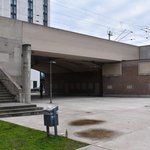
Wholesale market hall Frankfurt (Main) (Großmarkthalle Frankfurt (Main)) (1926)

Feed image of Wholesale market hall Frankfurt (Main)

#Industrial and technical building #Frankfurt (Main) #Germany #1926

Architects

Martin Elsaesser

Developers

Municipality Of Frankfurt (Main)

Address and directions

Sonnemannstraße 20
60314 Frankfurt (Main), Germany

Public transport: Ostbahnhof/Sonnemannstraße

Access: Public area during exhibitions or appointments

Today's use: Bank

From Wholesale Market Hall to European Central Bank

Description

As cities expanded, they required stronger infrastructure; in this case, a centralised location for the distribution of fruit and vegetables.

A useful point of comparison is the Wholesale market hall Leipzig, which is featured on our website. The building in Frankfurt was conceived on a grand scale: measuring 220 metres in length, 50 metres in width, and between 17 and 23 metres in height, it was the largest structure in the city at the time of its construction.

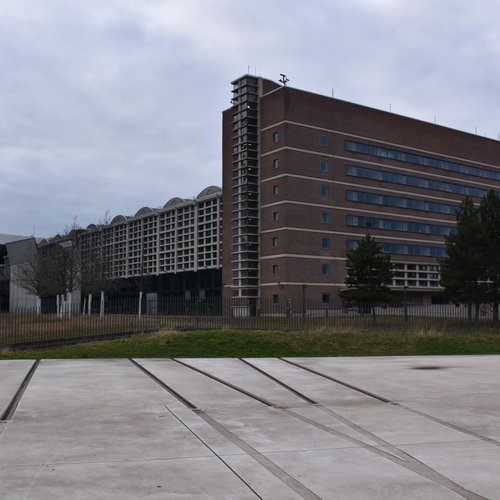
Inside, the hall accommodated 130 stalls. Its design allowed for highly efficient use of space, as there were no internal supports obstructing the interior. The roof consisted of 15 lightweight semi-cylindrical concrete shells, creating a wide, uninterrupted span. Large expanses of glazing are integrated throughout the hall, all supported by a structural concrete grid.

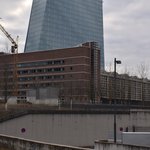
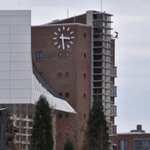
The hall was framed on the eastern and western sides by two head buildings, which housed administrative offices; the eastern block also contained a cold storage facility.

Also an own train station was part of the property.

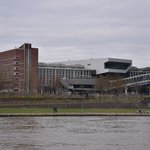
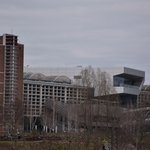
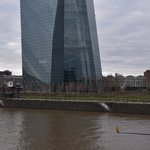
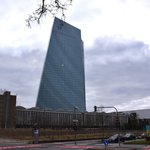
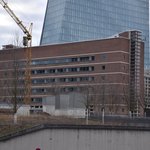
After the building became part of the European Central Bank, a section of the hall was demolished. A modern wedge-shaped structure, cylindrical in form, now provides a transition to the ECB’s high-rise tower.
Description

As cities expanded, they required stronger infrastructure; in this case, a centralised location for the distribution of fruit and vegetables.

A useful point of comparison is the Wholesale market hall Leipzig, which is featured on our website. The building in Frankfurt was conceived on a grand scale: measuring 220 metres in length, 50 metres in width, and between 17 and 23 metres in height, it was the largest structure in the city at the time of its construction.

Inside, the hall accommodated 130 stalls. Its design allowed for highly efficient use of space, as there were no internal supports obstructing the interior. The roof consisted of 15 lightweight semi-cylindrical concrete shells, creating a wide, uninterrupted span. Large expanses of glazing are integrated throughout the hall, all supported by a structural concrete grid.

The hall was framed on the eastern and western sides by two head buildings, which housed administrative offices; the eastern block also contained a cold storage facility.

Also an own train station was part of the property.

After the building became part of the European Central Bank, a section of the hall was demolished. A modern wedge-shaped structure, cylindrical in form, now provides a transition to the ECB’s high-rise tower.
History

Following experience gained from other market halls, the city of Frankfurt am Main approved the project on 14 June 1926. Construction continued until the official opening on 25 October 1928.

In addition to its primary function as a central distribution hub for fruit and vegetables, parts of the complex were misused from October 1941 for the deportation of the city’s Jewish population. People were assembled in the basement areas and then transported from the on-site railway station to concentration camps. Since 2015, this history has been commemorated within the building by a memorial dedicated to expulsion and the Holocaust.

In 1944, the building was damaged during bombing raids. As the city urgently required a functioning wholesale market hall for food supply, it was subsequently reconstructed. Restoration work was carried out in part under the direction of Martin Elsaesser.

The building was granted listed status in 1984. Its original function as a wholesale market continued until 4 June 2004. Following the transfer of ownership from the city to the European Central Bank in 2005, based on a contract agreed in 2002, the hall was redesigned to serve as the main entrance area of the ECB and was officially reopened in 2015.

To allow for the demolition of later extensions in 2008, their listed status was revoked.

History

Following experience gained from other market halls, the city of Frankfurt am Main approved the project on 14 June 1926. Construction continued until the official opening on 25 October 1928.

In addition to its primary function as a central distribution hub for fruit and vegetables, parts of the complex were misused from October 1941 for the deportation of the city’s Jewish population. People were assembled in the basement areas and then transported from the on-site railway station to concentration camps. Since 2015, this history has been commemorated within the building by a memorial dedicated to expulsion and the Holocaust.

In 1944, the building was damaged during bombing raids. As the city urgently required a functioning wholesale market hall for food supply, it was subsequently reconstructed. Restoration work was carried out in part under the direction of Martin Elsaesser.

The building was granted listed status in 1984. Its original function as a wholesale market continued until 4 June 2004. Following the transfer of ownership from the city to the European Central Bank in 2005, based on a contract agreed in 2002, the hall was redesigned to serve as the main entrance area of the ECB and was officially reopened in 2015.

To allow for the demolition of later extensions in 2008, their listed status was revoked.

Sources

Construction types
concrete skeleton
Facades
clinker brick concrete
Windows
casement fixed corner
Roof
flat curved
Details
clock canopy staircase
Position
along a street periphere/neighbourhood
Storeys
9

Impressions

Gallery image of Wholesale market hall Frankfurt (Main) Gallery image of Wholesale market hall Frankfurt (Main) Gallery image of Wholesale market hall Frankfurt (Main) Gallery image of Wholesale market hall Frankfurt (Main) Gallery image of Wholesale market hall Frankfurt (Main) Gallery image of Wholesale market hall Frankfurt (Main) Gallery image of Wholesale market hall Frankfurt (Main) Gallery image of Wholesale market hall Frankfurt (Main) Gallery image of Wholesale market hall Frankfurt (Main) Gallery image of Wholesale market hall Frankfurt (Main) Gallery image of Wholesale market hall Frankfurt (Main)