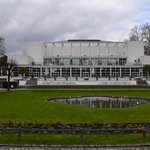
Palmengarten Society House (Gesellschaftshaus Palmengarten) (1928)

Feed image of Palmengarten Society House

#Restaurant #Frankfurt (Main) #Germany #1928

Architects

Martin Elsaesser, Ernst May, Werner Hebebrand

Developers

Aktiengesellschaft Siesmayer

Address and directions

Palmengartenstraße 11
60325 Frankfurt (Main), Germany

Public transport: Palmengartenstraße

Access: Public building, free entry during working hours

Today's use: Restaurant

Architecture, Social Life, and Historical Transformation

Description

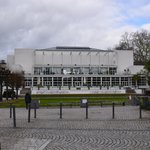
This building represents only the southern façade of the entire Gesellschaftshaus complex. The structure extends further north, where the 19th-century section contains the main ballroom. By contrast, the smaller southern part houses a restaurant and two additional side rooms.

This southern section forms a strong contrast to the Palmengarten, as it dates back to the 19th century. The fountain basin in front of the Gesellschaftshaus also originates from this period. Apart from the entrance building to the Palmengarten, it is the only structure accessible to the public from the outside of the park.

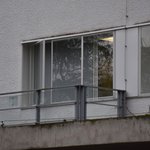
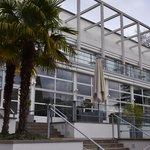
A broad flight of steps leads up to the entrance. Above this area, on the first floor, is a large terrace flanked by concrete pillars, which are integrated into the wall on the level above. The pillars are proportioned in a manner that reflects the two cubic volumes on the left and right. They articulate and define the space without filling it with solid mass. As a result, the main façade is arranged in a stepped composition. The whole building seems to be a wintergarden.

Inside, display cases filled with green plants are positioned between the tables, echoing the botanical theme and creating a connection between interior and exterior spaces. This display-like quality is also reflected in the exterior view, which invites visitors to enter.

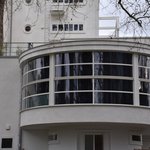
On the western side, the adjoining hall is complemented by a semi-circular room with large windows, further enhancing the building’s overall architectural impression.
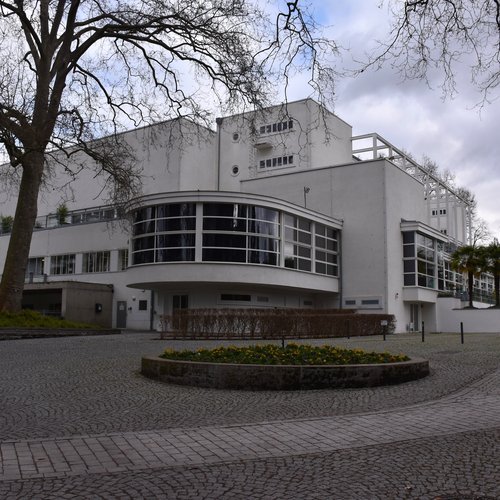
Description

This building represents only the southern façade of the entire Gesellschaftshaus complex. The structure extends further north, where the 19th-century section contains the main ballroom. By contrast, the smaller southern part houses a restaurant and two additional side rooms.

This southern section forms a strong contrast to the Palmengarten, as it dates back to the 19th century. The fountain basin in front of the Gesellschaftshaus also originates from this period. Apart from the entrance building to the Palmengarten, it is the only structure accessible to the public from the outside of the park.

A broad flight of steps leads up to the entrance. Above this area, on the first floor, is a large terrace flanked by concrete pillars, which are integrated into the wall on the level above. The pillars are proportioned in a manner that reflects the two cubic volumes on the left and right. They articulate and define the space without filling it with solid mass. As a result, the main façade is arranged in a stepped composition. The whole building seems to be a wintergarden.

Inside, display cases filled with green plants are positioned between the tables, echoing the botanical theme and creating a connection between interior and exterior spaces. This display-like quality is also reflected in the exterior view, which invites visitors to enter.

On the western side, the adjoining hall is complemented by a semi-circular room with large windows, further enhancing the building’s overall architectural impression.
History

In Frankfurt am Main, spaces dedicated to plants and a botanical garden had already existed since the 19th century. Across Germany, similar complexes were created, some of which still survive today. They offered a kind of alternate world—one that evoked warmth and a sense of floating in luxury or enjoying something “exotic.”

In Frankfurt, grand buildings were also added to serve social life. Among them was the Gesellschaftshaus, a venue for celebrations and events. The original south façade actually served as the model for the façade built in 1928, with its terraces and corner pavilions. Shortly after its completion, the building hosted the second meeting of the International Congress for Modern Architecture. Organized by Ernst May, the congress focused on the theme of the “minimum dwelling,” reflecting the housing projects of the Neues Frankfurt movement. As the city assumed greater control over the site, it took over the completed building in 1931, along with the entire Palmengarten.

During World War II, the west wing was destroyed and rebuilt in the 1950s. However, in 2002 the listed building underwent a further renovation, during which the postwar west wing was demolished and the form of the original structure was reconstructed.

History

In Frankfurt am Main, spaces dedicated to plants and a botanical garden had already existed since the 19th century. Across Germany, similar complexes were created, some of which still survive today. They offered a kind of alternate world—one that evoked warmth and a sense of floating in luxury or enjoying something “exotic.”

In Frankfurt, grand buildings were also added to serve social life. Among them was the Gesellschaftshaus, a venue for celebrations and events. The original south façade actually served as the model for the façade built in 1928, with its terraces and corner pavilions. Shortly after its completion, the building hosted the second meeting of the International Congress for Modern Architecture. Organized by Ernst May, the congress focused on the theme of the “minimum dwelling,” reflecting the housing projects of the Neues Frankfurt movement. As the city assumed greater control over the site, it took over the completed building in 1931, along with the entire Palmengarten.

During World War II, the west wing was destroyed and rebuilt in the 1950s. However, in 2002 the listed building underwent a further renovation, during which the postwar west wing was demolished and the form of the original structure was reconstructed.

Sources

Construction types
reinforced concrete
Facades
plaster
Windows
casement fixed ribbon corner
Roof
flat gable
Details
pergola railing winter garden roof terrace oriel pillar circular building
Position
with/in a garden/park periphere/neighbourhood
Storeys
3

Impressions

Gallery image of Palmengarten Society House Gallery image of Palmengarten Society House Gallery image of Palmengarten Society House Gallery image of Palmengarten Society House Gallery image of Palmengarten Society House Gallery image of Palmengarten Society House Gallery image of Palmengarten Society House