The most significant phase of Werner Hebebrand’s career for this context was his involvement in the Neues Frankfurt project between 1925 and 1929. After leaving the programme, he established himself as an independent architect.
He subsequently followed Ernst May to the Soviet Union, where he worked until being expelled in 1937. During this period, his work focused primarily on heavy industry and hospital construction.
Upon returning to Germany, he contributed to the planning of Salzgitter and its industrial complex. Despite his proximity to the ruling National Socialist regime, he was classified as politically unproblematic after the Second World War.
In the post-war period, he initially played a role in urban reconstruction in Frankfurt am Main and later in Hamburg, where he was involved in both rebuilding and restructuring efforts.
Sources
Buildings
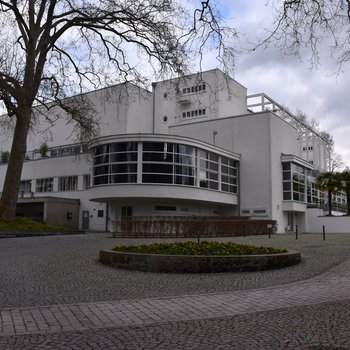
Frankfurt (Main), Germany
Palmengarten Society House