The history of public broadcasting in Belgium mirrors the country’s political division into distinct linguistic communities. In 1930
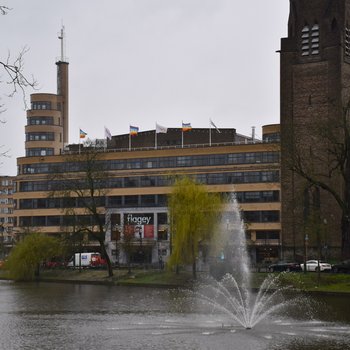
, the government founded the National Institute of Radio Broadcasting (INR/NIR). Modeled closely after the British BBC, it provided separate radio streams in both French and Dutch from its iconic Flagey Building
headquarters in Brussels. During the Second World War, the infrastructure was seized by occupying German forces for propaganda broadcasts, while the Belgian government-in-exile broadcasted Radio Belgique from London via the BBC. After the war, the state monopoly was restored, and in October 1953, regular television broadcasts were introduced
.
As cultural and linguistic tensions grew, a centralized system became unsustainable. A landmark law in 1960 dissolved the unitary INR-NIR
, splitting it into two autonomous public entities: the Dutch-language BRT
and the French-language RTB. In 1974, both broadcasters moved to the new Reyers media complex. Following state federalisation reforms in the late 1970s, absolute authority over broadcasting was transferred to the regional communities. Today, Belgium’s public media is completely divided into independent corporations: VRT
for the Flemish region, RTBF for the French-speaking community, and BRF
for the small German-speaking population.
Sources
Buildings
Brussels (Bruxelles), Belgium
National Radio Broadcasting Institute