Wilhelm Kreis was a highly influential German architect whose career spanned four tumultuous eras of German history. Later in 1926, he succeeded Heinrich Tessenow as a professor at the Dresden Kunstakademie, marking a significant stylistic evolution. Moving away from his earlier historicised designs, he embraced a stripped-back, monumental modernism. His absolute masterpiece from this period is the Deutsches Hygiene-Museum, built in 1927–1930, which perfectly combined clean, functional lines with a powerful neoclassical geometry. During his time in Dresden, he also served as the President of the Association of German Architects (BDA)
until 1933.
Following the Nazi rise to power, Kreis was initially dismissed from his presidency but swiftly adapted, officially joining the NSDAP in October 1933. His career experienced a major resurgence when Albert Speer
recruited him for state-level projects. Kreis utilised his expertise in monumental design to create massive plans for war cemeteries and the colossal Soldatenhalle for the envisioned transformation of Berlin. In Dresden, he designed the Luftgaukommando IV building (1937–1938). He accumulated immense power, becoming Generalbaurat
for German war graves in 1941, President of the Reich Chamber of Fine Arts
in 1943, and was included on the Gottbegnadeten list in 1944.
Despite his high-profile involvement with the regime, Kreis successfully navigated the post-wardenazification process
, where he was classified as a mere follower (Mitläufer
). Relocating to Bad Honnef
in 1949, he continued to receive architectural commissions in West German, designing residential buildings, hotels, and commercial structures like the Landeszentralbank in Dortmund. In 1953, the Federal Republic of Germany awarded him the Federal Cross of Merit
(Bundesverdienstkreuz), cementing his rehabilitation in democratic society.
Sources
Buildings
Düsseldorf, Germany
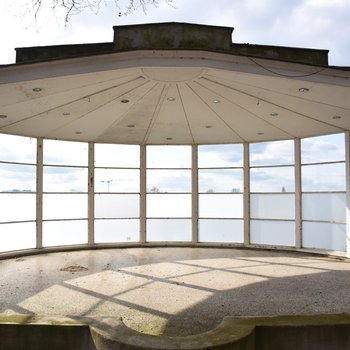
Rhine Terrace Pavilion