Joseph Diongre was a pivotal Belgian architect whose interwar career defined the transition from traditional academicism to pioneering Modernism
architecture.
Following the First World War, Diongre radically broke away from his early eclectic roots to embrace functional public design. His modernist breakthrough came in 1927 with the celebrated Withuis
("White House") in Jette, built for the poet Jef Mennekens. This avant-garde residential masterpiece showcased bold, cubist geometric layouts and custom-designed Art Deco interior features, establishing Diongre as a frontrunner of the new architectural movement.
During the 1930s, Diongre evolved his style into a powerful, monumental form often described as Hard Modernism. He became Belgium’s foremost specialist in large-scale public commissions, leaving behind two major structural legacies. The church of Saint-Jean-Baptiste (1931) and the Flagey Building (1935–1938). He was known for its advanced acoustic engineering, its fluid, aerodynamic corners and tiered tower earned it the permanent nickname The Packet Boat (Paquebot), making it a global icon of the Streamline Moderne era.
Through these milestone projects, Diongre successfully merged industrial functionality with artistic elegance, leaving an indelible mark on the urban fabric of Brussels. Diongre passed away at the age of 84. Shortly before his death, he intentionally destroyed a vast majority of his personal architectural archives.
Sources
Buildings
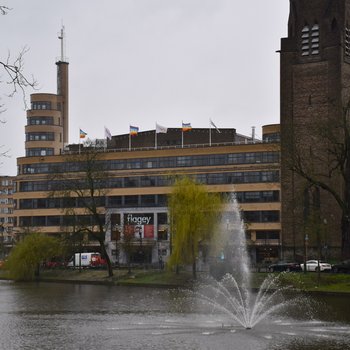
Brussels (Bruxelles), Belgium
National Radio Broadcasting Institute