He is often regarded as a key figure of modernism in Slovakia. At the same time, his connections to Germany are frequently highlighted, as it was there that he studied and became acquainted with new people and technologies that influenced his work.
The various forms of his first name symbolise the fluidity of cultural perception: “Friedrich” appears in more international contexts and on his Stolperstein in Bratislava. “Fridrich” is found in some Slovak sources and “Bedrich” or “Bedřich” reflects the Slovak or Czech and form. However, this name developed later in his life. He was originally born as Alfred József, a distinctly Hungarian name, which reflects the political situation at the time, when his birthplace was still under Hungarian administration.
After the First World War, he settled in Bratislava as an independent architect. From 1924 onwards, he and Ignác Vécsei created a series of purist and pioneering works through their shared architectural practice. They were active in their office until 1938. In parallel, he also edited and published the journal Nová Bratislava.
His left-wing convictions, his commitment to creating affordable housing for poorer people, and his Jewish background ultimately proved fatal for him in the Nazi-aligned Slovak State. He was first forced to close his architectural studio. To this day, nobody knows exactly where or when exectly he died in 1942; it is assumed that he perished while attempting to escape after his imprisonment in Ilava in 1941.
Today, a Stolperstein for Friedrich Weinwurm in front of his former residence at Gorkého 11 in Bratislava commemorates his life and fate.

Sources
- Wikipedia Friedrich Weinwurm
- register-architektury.sk Friedrich Weinwurm
- Moravčíková: Friedrich Weinwurm, 2014
Buildings
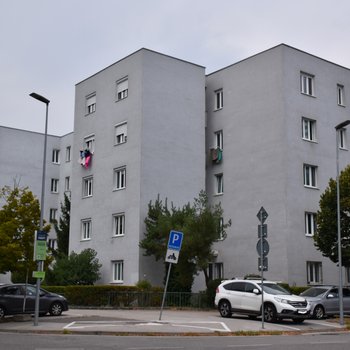
Bratislava, Slovakia
New Era