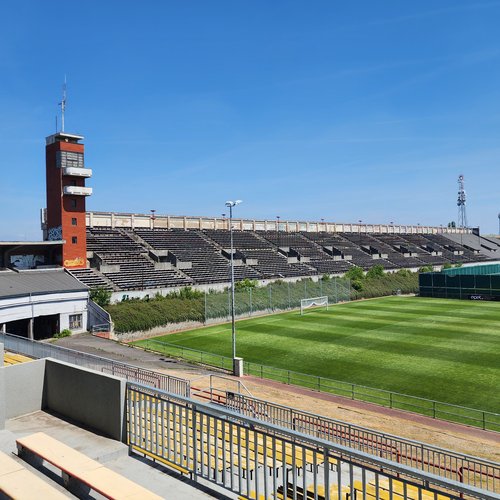
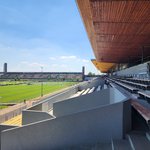
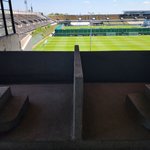
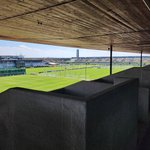
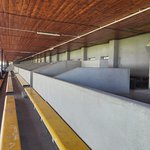
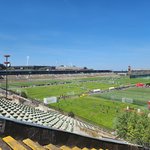
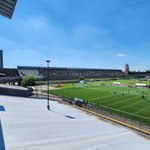
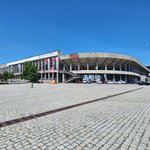
The official name of the venue is the Great Strahov Stadium (Velký strahovský stadion), distinguishing it from the two smaller stadiums located immediately to its west.
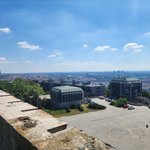
The vast complex covers an area equivalent to seven football pitches. Its stands provide seating for approximately 56,000 spectators, while the site has accommodated crowds of up to 250,000 people during major events. This remarkable capacity makes it the largest stadium of the modern era, surpassed only by the historic Circus Maximus in ancient Rome.
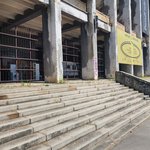
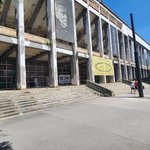
The stadium was developed in several phases. The first major construction stage took place between 1930 and 1932, when the West Stand was built around the central field. It features a timber roof, allowing spectators to remain sheltered in all weather conditions. These sections are connected by structures incorporating two prominent towers. Architecturally, they display many characteristics of early modernism, like balconies, a lookout platform and big windows. Their simple vertical elements create a striking contrast with the stadium’s vast horizontal expanse.Today, this section of the stadium has been largely renovated.
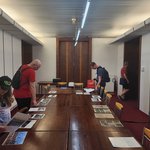
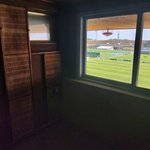
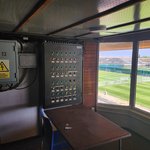
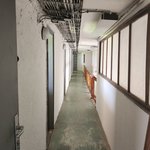
Access to a number of interior rooms is provided from the West Stand. Among them is the Presidential Hall, whose furnishings date from the 1970s. The technical facilities and the press rooms are also located here; the latter still retain their original wooden panelling.
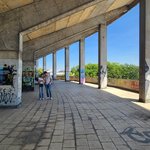
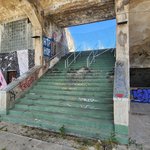
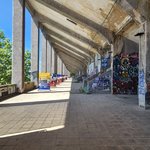
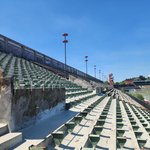
The North and South Stands were added between 1938 and 1947. Today they are in a bad condition.
The East Stand was constructed later, between 1962 and 1975, completing the stadium's present form, designed by the architects Zdeněk Kuna, Zdeněk Stupka and Olivier Honke-Houfek. Although the North and South Stands are built of reinforced concrete, their repetitive and highly regular design recalls classical architectural principles. This is somewhat surprising, as the material itself would have allowed for a more open and expressive architectural language.
Together with the later East Stand, these imposing structures have led many visitors to assume that the stadium was built during the socialist period, when such monumental forms were frequently employed. In reality, much of the complex predates that era.
Today, the condition of this listed architectural ensemble is often a source of regret. However, no comprehensive restoration programme is currently planned, particularly for the North and South Stands.
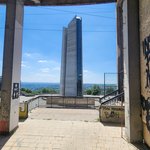
The large concrete tower on the southern side in front of the stadium was designed to match the architectural style of the stadium. However, it is not directly related to the stadium itself. Instead, it serves as a ventilation exhaust shaft for the road tunnel that runs beneath the site.