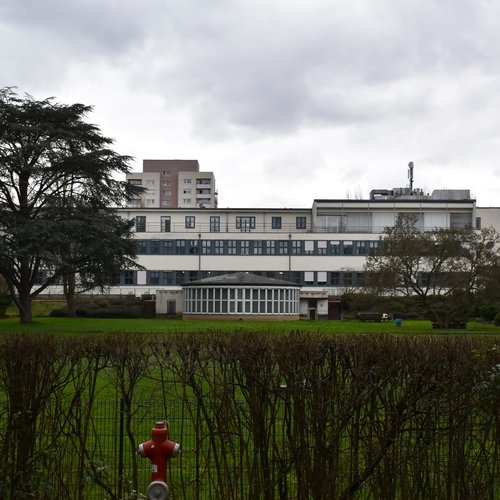
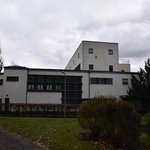
The present building represents a simplified version of the original design, which had envisaged a circular complex. Instead, a main building housing examination and administrative rooms was constructed to the north. The two semi-circular extensions on the northern side accommodate the kitchen in the north-east wing and the lecture theatre in the north-west wing.
A large terrace is located on the upper floor, offering views towards the patient wards. The southern semi-circular projection houses the chapel. Extending southwards are the two wings containing the patient rooms; above ground they appear structurally separate from the main building, but are connected underground.
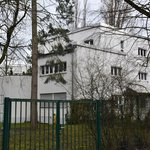
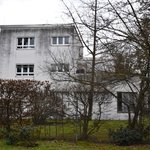
The surrounding green spaces give the complex a secluded atmosphere. To the north lie the residential buildings for the clinic staff. Houses numbered 2, 4, 6, 8, 12, 14, 16 and 18 contained staff accommodation. Houses 8 and 12, located centrally, each comprised eight flats, while the others contained ten flats each. This means that at least 76 members of staff lived on site. Short distances were undoubtedly practical, though one might question whether living in constant view of one’s workplace was always desirable. In any case, it saved time and improved efficiency. The residential buildings are arranged in two blocks, separated in the middle, forming a kind of gateway or entrance to the clinic.
House number 2a was the director’s villa, part of the complex and also reflecting the hierarchical organisation of living arrangements. Surprisingly it was not equipped with a garage in the house.
All residential buildings feature semi-circular extensions facing towards the clinic. Houses 8 and 12 have smaller terraces, while the villa at number 2a has a large terrace.