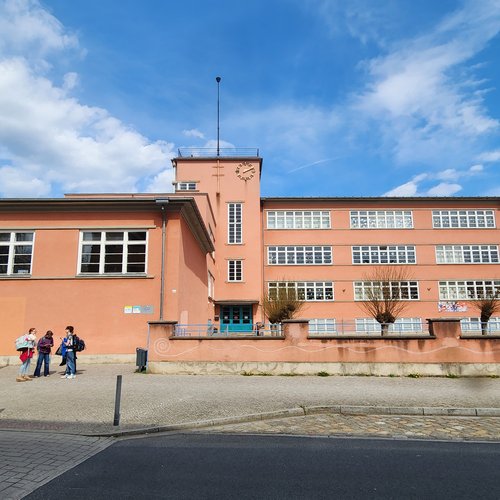
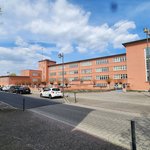
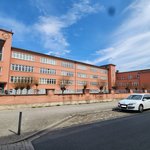
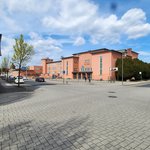
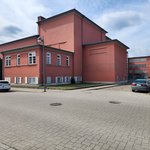
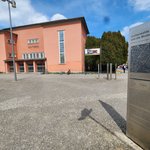
From an architectural perspective, the two buildings are organically integrated into a single complex. The city had already planned to build a new school before 1914, but financial difficulties delayed the project until it was revived in 1924.
The resulting design incorporated the theatre as a flexible, multi-purpose space. The school was provided with an assembly hall that could also serve as a public theatre, allowing the city to reduce construction costs.
As the project was promoted by the Social Democratic Party, the school was named after Friedrich Ebert, the first President of the Weimar Republic.
Construction took place between 1927 and 1930, and the school complex was officially inaugurated on 7 and 8 August 1930. Just over a month later, on 29 September 1930, the theatre opened with a performance of the operetta Die Fledermaus (The Bat).
After the Nazis came to power in 1933, the school was renamed. In 1944, it was even converted into a facility serving the armaments industry. Following the Second World War, the building was used by the Soviet Red Army as an officers' club. From 1952 onwards, it once again served as a school. In 1990, its original name was restored, and today it is once again known as the Friedrich Ebert School.