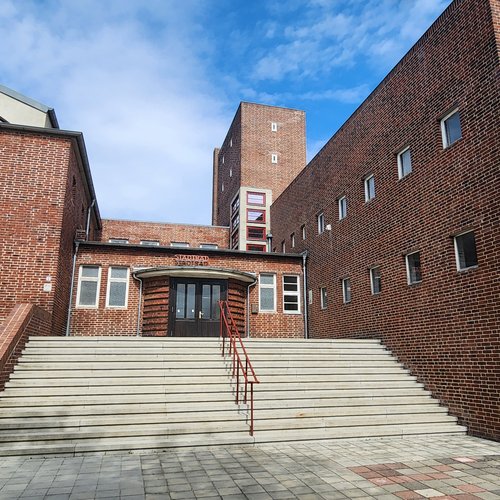
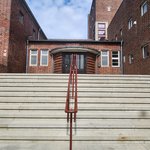
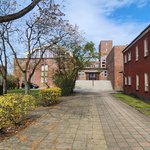
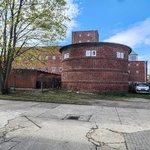
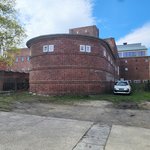
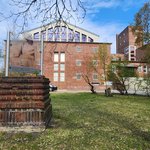
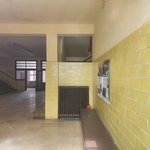
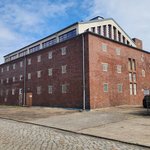
The brick building is composed of a series of interconnected cubic volumes. Visitors enter the building via a staircase leading to the main entrance.
The compact structure is divided into two principal sections. The eastern wing contains the changing rooms as well as ancillary facilities, including the saunas. The flat roofs were originally designed to serve as sun terraces.
The western hall houses the swimming pool, which is enclosed by a light-filled reinforced concrete roof with clerestory windows. During the most recent renovation, the upper section of the hall was modernized.
The pool itself gradually deepens from the shallow non-swimmers' area to the deeper section, where bathers can no longer stand. A first-floor gallery surrounds the pool hall, with changing cabins arranged along its perimeter, mirroring the layout of the ground floor.
The building's vertical emphasis is provided by the prominent stair tower.
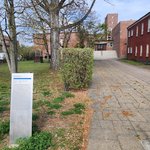
In front of the entrance, on a small forecourt, only a brick pedestal remains, designed in keeping with the architectural style of the bathhouse. It once supported the sculpture The Bathing Woman (also known as The Crouching Woman) by Hermann Nonnenmacher. The sculpture was classified by the Nazi regime as "degenerate art" and was removed and destroyed as early as 1933.