Wenke's department store (Wenkeův obchodní dům) (1910)

Feed image of Wenke's department store

#Department store #Jaroměř #Czechia #1910

Architects

Josef Gočár

Developers

Josef Wenke

Address and directions

Husova 295
551 01 Jaroměř, Czechia

Public transport: Husova

Access: Public building, free entry during working hours

Today's use: Museum

The First Glass Curtain Wall on the European Continent

Description

Curtain wall windows are not a defining feature of classical modernism; they were first used as early as 1864 in Liverpool for the Oriel Chambers. It took some time, however, for this architectural element to spread across Europe.

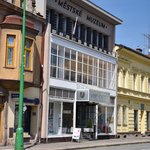
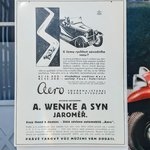
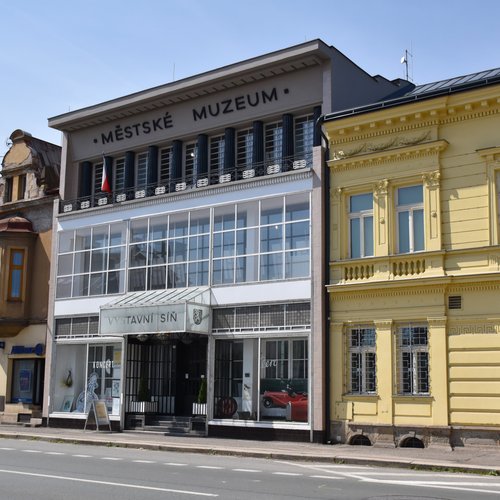
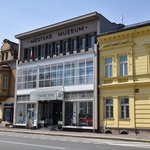
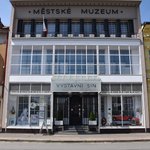
This building still bears traces of Czech Cubism, yet it already points towards the emerging modern movement. A key contribution to this transition is the extensive use of glass: on the ground floor, large glazed areas accommodate both the shopfront and the entrance. Above the entrance, a small glass canopy has been installed. Originally, the name A. Wenke a syn was displayed in this position.

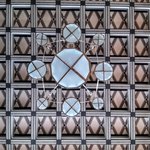
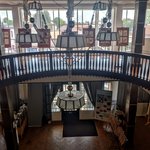
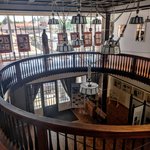
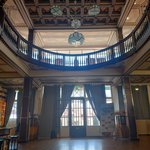
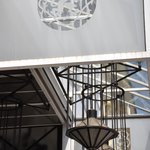
The large panes of glass flood the interior with light. The ground floor space is notably elongated and only receives additional daylight from side windows towards the rear. Light is further orchestrated within the building itself: the ceiling of the ground floor is partially opened in the centre, allowing light from the first floor to filter through. This arrangement creates a spatial effect more reminiscent of a villa than a commercial building. The chandelier mounted on the ceiling is original, as is the service lift.

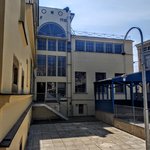
In terms of its external appearance, the building establishes a clear hierarchy between the street-facing façade and the rear. The façade towards the street is more articulated and representative, while the rear is designed more simply and culminates in a terrace at roof level.

The inscription Městské muzeum (City Museum) on the top of the building was added only later, reflecting the building’s new function, and replaced the original sign Továrna a velkoobchod galanterní (factory and wholesale haberdashery business).
Description

Curtain wall windows are not a defining feature of classical modernism; they were first used as early as 1864 in Liverpool for the Oriel Chambers. It took some time, however, for this architectural element to spread across Europe.

This building still bears traces of Czech Cubism, yet it already points towards the emerging modern movement. A key contribution to this transition is the extensive use of glass: on the ground floor, large glazed areas accommodate both the shopfront and the entrance. Above the entrance, a small glass canopy has been installed. Originally, the name A. Wenke a syn was displayed in this position.

The large panes of glass flood the interior with light. The ground floor space is notably elongated and only receives additional daylight from side windows towards the rear. Light is further orchestrated within the building itself: the ceiling of the ground floor is partially opened in the centre, allowing light from the first floor to filter through. This arrangement creates a spatial effect more reminiscent of a villa than a commercial building. The chandelier mounted on the ceiling is original, as is the service lift.

In terms of its external appearance, the building establishes a clear hierarchy between the street-facing façade and the rear. The façade towards the street is more articulated and representative, while the rear is designed more simply and culminates in a terrace at roof level.

The inscription Městské muzeum (City Museum) on the top of the building was added only later, reflecting the building’s new function, and replaced the original sign Továrna a velkoobchod galanterní (factory and wholesale haberdashery business).
History

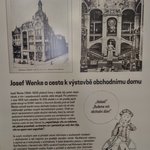
After his father’s death in 1905, Josef Wenke took sole charge of the cardboard and shell goods business. He acquired the neighbouring plot, including its garden, and his brother-in-law Josef Máša introduced him to the architect Josef Gočár, who produced designs for a new department store in 1909. Construction began in 1910, and the building officially opened on 16 May 1911, marking the peak of the company’s success.

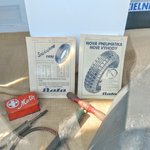
The years that followed proved challenging. In 1917, the well-known Czechoslovak shoe manufacturer Baťa was brought in as a tenant to ensure the retail space remained economically viable. This marked the beginning of a series of changing uses for the building, culminating in its sale as early as 1938. By 1947, the premises were already being used by the local museum. Between 1985 and 2023, the building underwent three phases of modernisation, and in 2017 it was designated a national cultural monument.

History

After his father’s death in 1905, Josef Wenke took sole charge of the cardboard and shell goods business. He acquired the neighbouring plot, including its garden, and his brother-in-law Josef Máša introduced him to the architect Josef Gočár, who produced designs for a new department store in 1909. Construction began in 1910, and the building officially opened on 16 May 1911, marking the peak of the company’s success.

The years that followed proved challenging. In 1917, the well-known Czechoslovak shoe manufacturer Baťa was brought in as a tenant to ensure the retail space remained economically viable. This marked the beginning of a series of changing uses for the building, culminating in its sale as early as 1938. By 1947, the premises were already being used by the local museum. Between 1985 and 2023, the building underwent three phases of modernisation, and in 2017 it was designated a national cultural monument.

Sources

Construction types
reinforced concrete
Facades
plaster
Windows
casement fixed
Roof
flat
Details
glass block canopy lettering cornice
Position
along a street periphere/neighbourhood
Storeys
3

Impressions

Gallery image of Wenke's department store Gallery image of Wenke's department store Gallery image of Wenke's department store Gallery image of Wenke's department store Gallery image of Wenke's department store Gallery image of Wenke's department store Gallery image of Wenke's department store Gallery image of Wenke's department store Gallery image of Wenke's department store Gallery image of Wenke's department store Gallery image of Wenke's department store Gallery image of Wenke's department store Gallery image of Wenke's department store