Riederwald (1926)

Feed image of Riederwald

#Housing estate #Frankfurt (Main) #Germany #1926

Architects

Ernst May, Herbert Boehm, Otto Fucker, Eduard Fucker, Franz Thyriot, Karl Moritz

Developers

Hochbauamt Stadt Frankfurt

Address and directions

Am Erlenbruch; Friedrich-Liszt-Straße; Görresstraße; Karl-Marx-Straße; Lassallestraße; Schäfflestraße
60386 Frankfurt (Main), Germany

Public transport: Schäfflestraße

Today's use: Housing estate

Description

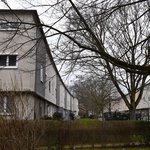
A total of 313 houses were built as an extension of the existing estate, based on plans by Ernst May and Herbert Boehm. These comprised detached, semi-detached, and multi-family houses.

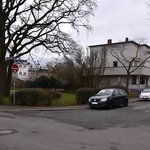
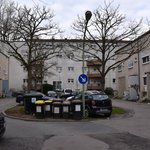
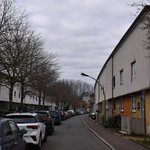
The central axis is Lassallestraße, from which the surrounding streets branch off to the north and south. To the north, Görresstraße, Karl-Marx-Straße, and Friedrich-List-Straße are laid out as looped streets ending in cul-de-sacs. They are set slightly back from Lassallestraße, partly screened by a row of terraced houses positioned perpendicular to the narrow street.

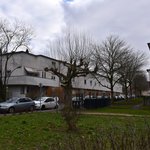
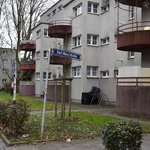
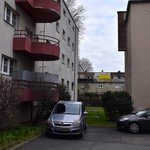
The street itself, along with the houses lining it, is further shielded by four larger buildings to the north along Am Erlenbruch. With their distinctive rounded balconies highlighted in red and their avant-corps, these buildings form a striking boundary to or gateway into the estate. Today, they also serve a practical purpose by helping to reduce traffic noise within the neighbourhood.

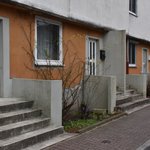
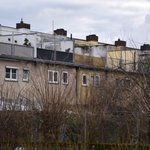
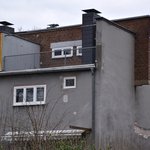
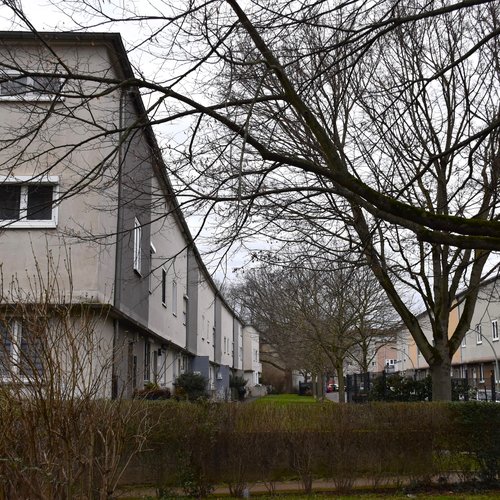
South of Lassallestraße, three rows of houses extend almost as far as towards the street Raiffeisenstraße. They start at Lassallestraße with the first building designed with a balcony on first floor. All the terraced houses in the estate have access to an own garden. Most of them in the row are equipped with roof terraces.

Also planned at the time were the Church of the Holy Spirit to the west and the Pestalozzi School to the north of the estate. Although they formed part of the original planning concept, they are treated separately here.
Description

A total of 313 houses were built as an extension of the existing estate, based on plans by Ernst May and Herbert Boehm. These comprised detached, semi-detached, and multi-family houses.

The central axis is Lassallestraße, from which the surrounding streets branch off to the north and south. To the north, Görresstraße, Karl-Marx-Straße, and Friedrich-List-Straße are laid out as looped streets ending in cul-de-sacs. They are set slightly back from Lassallestraße, partly screened by a row of terraced houses positioned perpendicular to the narrow street.

The street itself, along with the houses lining it, is further shielded by four larger buildings to the north along Am Erlenbruch. With their distinctive rounded balconies highlighted in red and their avant-corps, these buildings form a striking boundary to or gateway into the estate. Today, they also serve a practical purpose by helping to reduce traffic noise within the neighbourhood.

South of Lassallestraße, three rows of houses extend almost as far as towards the street Raiffeisenstraße. They start at Lassallestraße with the first building designed with a balcony on first floor. All the terraced houses in the estate have access to an own garden. Most of them in the row are equipped with roof terraces.

Also planned at the time were the Church of the Holy Spirit to the west and the Pestalozzi School to the north of the estate. Although they formed part of the original planning concept, they are treated separately here.
History

The Riederwald estate developed as a continuous settlement near the eastern harbour. Construction began in 1909 with the western section, built in the so-called Heimatstil (a traditional, regionally inspired architectural style).

Work resumed in 1926 and 1927 with the eastern part, as part of the Neues Frankfurt urban development programme. Further building continued intermittently until the 1980s.

The oldest section in the west is now listed as a protected heritage area. The streets throughout the neighbourhood are named after figures associated in various ways with social housing—for example, Schulze-Delitzsch, one of the founders of the cooperative movement in Germany.

In 2011, the estate was featured repeatedly from the 13th minute onwards in the episode Der Tote im Nachzug of the popular German crime series Tatort.

History

The Riederwald estate developed as a continuous settlement near the eastern harbour. Construction began in 1909 with the western section, built in the so-called Heimatstil (a traditional, regionally inspired architectural style).

Work resumed in 1926 and 1927 with the eastern part, as part of the Neues Frankfurt urban development programme. Further building continued intermittently until the 1980s.

The oldest section in the west is now listed as a protected heritage area. The streets throughout the neighbourhood are named after figures associated in various ways with social housing—for example, Schulze-Delitzsch, one of the founders of the cooperative movement in Germany.

In 2011, the estate was featured repeatedly from the 13th minute onwards in the episode Der Tote im Nachzug of the popular German crime series Tatort.

Sources

Construction types
masoned hollow blocks made of pumice concrete
Facades
plaster
Windows
casement
Roof
flat gable
Details
balcony avant-corps roof terrace canopy gable
Position
along a street periphere/neighbourhood
Storeys
3

Impressions

Gallery image of Riederwald Gallery image of Riederwald Gallery image of Riederwald Gallery image of Riederwald Gallery image of Riederwald Gallery image of Riederwald Gallery image of Riederwald Gallery image of Riederwald Gallery image of Riederwald Gallery image of Riederwald Gallery image of Riederwald Gallery image of Riederwald Gallery image of Riederwald