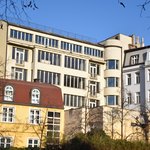
Palace U Stýblů/Alfa (Palác U Stýblů/Alfa) (1927)

Feed image of Palace U Stýblů/Alfa

#Multifunctional building #Prague (Praha) #Czechia #1927

Architects

Jan Jarolím, Ludvík Kysela

Developers

Václav Stýblo

Address and directions

Václavské náměstí 785/28
110 00 Prague (Praha), Czechia

Public transport: Můstek / Václavské náměstí

Today's use: Shops on ground floor

A place, where culture and social life took place in a great architecture.

Description

This truly grand Functionalist building accommodated a variety of uses. Thanks to its reinforced-concrete frame, the interior spaces are flooded with natural light. Many original details survive, as the building has never undergone a comprehensive modernisation. From the side facing the square, the extensive glazing is particularly striking.

On the ground floor, shops line the square, the passageway, the rear section and a small adjoining wing. A central passage leads through to the inner courtyard and the back of the building, while also providing access to the small park of Františkovy sady.

The first floor is defined by a long expanse of windows. It was originally conceived as a large café overlooking the square and arranged around the passage. Offices and flats occupied the second to sixth floors. In this section, two projecting oriel bays stand out, lending the façade a stronger sense of rhythm. Between them, on the second floor, is a balcony.

The eighth storey is set back and features terraces and two winter gardens. The flagpoles are ornamented at their upper ends with an “S”, the initial of the Stýblo publishing house.

From the passage there was access, via two basement levels, to the Alfa cinema, the original lettering still survives, as well as to the legendary Semafor Theatre. The glazed ceiling of the passage is likewise supported by a reinforced-concrete frame into which glass blocks have been set.

Description

This truly grand Functionalist building accommodated a variety of uses. Thanks to its reinforced-concrete frame, the interior spaces are flooded with natural light. Many original details survive, as the building has never undergone a comprehensive modernisation. From the side facing the square, the extensive glazing is particularly striking.

On the ground floor, shops line the square, the passageway, the rear section and a small adjoining wing. A central passage leads through to the inner courtyard and the back of the building, while also providing access to the small park of Františkovy sady.

The first floor is defined by a long expanse of windows. It was originally conceived as a large café overlooking the square and arranged around the passage. Offices and flats occupied the second to sixth floors. In this section, two projecting oriel bays stand out, lending the façade a stronger sense of rhythm. Between them, on the second floor, is a balcony.

The eighth storey is set back and features terraces and two winter gardens. The flagpoles are ornamented at their upper ends with an “S”, the initial of the Stýblo publishing house.

From the passage there was access, via two basement levels, to the Alfa cinema, the original lettering still survives, as well as to the legendary Semafor Theatre. The glazed ceiling of the passage is likewise supported by a reinforced-concrete frame into which glass blocks have been set.

History

The building was constructed in 1927–28 for Václav Stýblo as a mixed-use development comprising offices and flats, as well as a cinema, theatre, café and shops. It replaced two earlier houses on the site. The dance café on the first floor was originally called Boulevard and was later renamed Alfa, in keeping with the cinema. As a result, many Prague residents began referring to the building as the Alfa Palace (Palác Alfa) rather than U Stýblů.

In 1948, following the wave of nationalisations introduced by the new Czechoslovak communist government, the property was confiscated from the Stýblo family.

The building was listed as a cultural monument in 1958 and underwent its first renovation in the 1960s. After 1989 it was returned to the family, and a second modernisation was begun, although this was never completed. Today, the building stands largely vacant, with the exception of the ground-floor premises. It is currently owned by Ondřej Stýblo.

From a cultural and historical perspective, the building is notable as the venue for the premiere of the Czechoslovak film Tonka Šibenice in February 1931. Although originally shot as a silent film, it was subsequently released with synchronised dialogue and is therefore regarded by some historians as the first Czech sound film.

The Nové divadlo, founded by the actor Oldřich Nový, was established in the basement with seating for 260. It functioned as an experimental theatre until it was banned in 1948. In the 1960s, the same premises housed the Semafor Theatre, which played an important role in fostering the cultural atmosphere that contributed to the Prague Spring.

Some old pictures are on this website.

History

The building was constructed in 1927–28 for Václav Stýblo as a mixed-use development comprising offices and flats, as well as a cinema, theatre, café and shops. It replaced two earlier houses on the site. The dance café on the first floor was originally called Boulevard and was later renamed Alfa, in keeping with the cinema. As a result, many Prague residents began referring to the building as the Alfa Palace (Palác Alfa) rather than U Stýblů.

In 1948, following the wave of nationalisations introduced by the new Czechoslovak communist government, the property was confiscated from the Stýblo family.

The building was listed as a cultural monument in 1958 and underwent its first renovation in the 1960s. After 1989 it was returned to the family, and a second modernisation was begun, although this was never completed. Today, the building stands largely vacant, with the exception of the ground-floor premises. It is currently owned by Ondřej Stýblo.

From a cultural and historical perspective, the building is notable as the venue for the premiere of the Czechoslovak film Tonka Šibenice in February 1931. Although originally shot as a silent film, it was subsequently released with synchronised dialogue and is therefore regarded by some historians as the first Czech sound film.

The Nové divadlo, founded by the actor Oldřich Nový, was established in the basement with seating for 260. It functioned as an experimental theatre until it was banned in 1948. In the 1960s, the same premises housed the Semafor Theatre, which played an important role in fostering the cultural atmosphere that contributed to the Prague Spring.

Some old pictures are on this website.

Sources

Sources

Construction types
reinforced concrete
Facades
plaster
Windows
casement ribbon
Roof
flat
Details
balcony flagpole railing terrace winter garden avant-corps lettering
Position
along a street centre of a city/town/village
Storeys
8

Impressions

Gallery image of Palace U Stýblů/Alfa Gallery image of Palace U Stýblů/Alfa Gallery image of Palace U Stýblů/Alfa Gallery image of Palace U Stýblů/Alfa Gallery image of Palace U Stýblů/Alfa Gallery image of Palace U Stýblů/Alfa Gallery image of Palace U Stýblů/Alfa Gallery image of Palace U Stýblů/Alfa Gallery image of Palace U Stýblů/Alfa