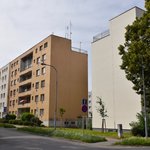
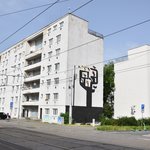
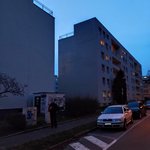
The political and economic situation following the Great Depression prompted the state to promote the construction of very small flats. These apartments measured around 30 square metres and consisted of a small entrance hall, a kitchen, a living room, and compact ancillary spaces containing a toilet, shower and pantry. The block on Vranovská Street follows the course of the road, meaning that the complex itself is not symmetrical but instead takes on a more trapezoidal form.
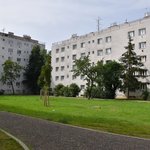
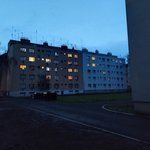
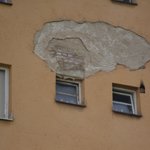
Six of the blocks rise to five residential storeys and contain 25 flats each, while the seven-storey block provides 30 flats. Altogether, the complex offered 210 apartments, primarily intended for single occupants. From the outside, each flat can be identified by its pair of windows, while the smaller adjacent window served to ventilate the compact service rooms.
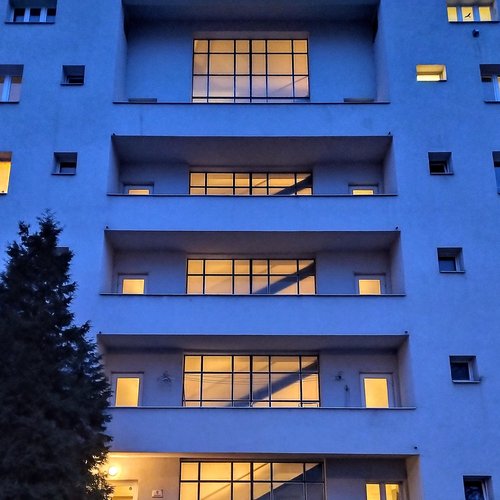
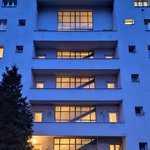
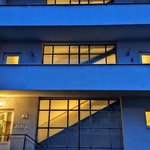
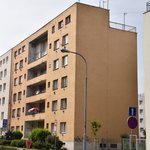
The buildings are accessed via striking staircases positioned centrally on the street-facing side. These stairwells form an important architectural feature of the design, with the staircases visible behind large windows, like ribbon windows. At each level, broad balconies provide access to the open air.
All of the buildings also include an additional upper floor. On the street side, this level originally accommodated communal facilities such as drying rooms. On the courtyard side, it opens onto a terrace that was once used by residents for sunbathing.