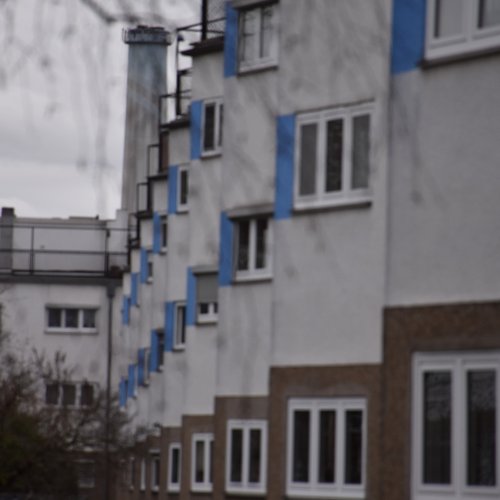
Bruchfeldstraße (Zickzackhausen) (1926)

Feed image of Bruchfeldstraße

#Housing estate #Frankfurt (Main) #Germany #1926

Architects

Ernst May, Carl-Hermann Rudloff

Developers

Aktienbaugesellschaft für kleine Wohnungen (ABG)

Address and directions

Breubergstraße 6, 8, 10, 12, 14, 16, 18, 20, 22, 24, 26-31, 33,, 35, 37, 39, 41, 43; Bruchfeldstraße 83, 85, 87, 89, 91, 93, 95, 97, 99, 101, 103, 105, 107, 109, 111, 113; Donnersbergstraße 1, 3, 5, 7-26, 28, 30, 32, 34, 36, 38,40, 42 44, 46 48 50, 52, 54 56 58, 60, 62, 64 66; Goldsteinstraße 70, 72; Haardtwaldstraße 2, 4, 6, 8, 10, 23, 25, 27, 29, 31, 33; Kalmitstraße 1, 3, 5, 7, 9; Melibocusstraße 18, 20, 22, 24-32; Trifelstraße 2, 4, 6, 8; Zentralbau bzw. Verbindungsbau zwischen Breubergstraße 8 und Bruchfeldstraße 83
60528 Frankfurt (Main), Germany

Public transport: Niederrad / Odenwaldstraße

Access: Public building, free entry during working hours

Today's use: Apartments, kindergarten, shops
Between Block Tradition and Modern Living

Description

As the topography played a decisive role in shaping the development, the planning here is closely integrated into the existing urban fabric. Rather than being conceived as a detached satellite estate in the green, it was more organically connected to the surrounding city and built upon earlier plans for the site. The layout of the estate was designed by Ernst May in collaboration with Herbert Boehm, while the architectural design was carried out by Ernst May together with Carl-Hermann Rudloff.

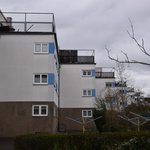
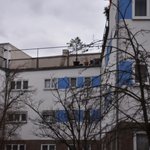
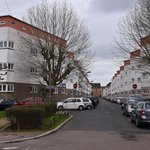
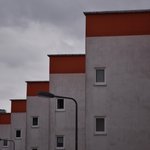
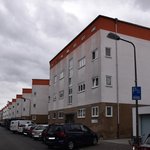
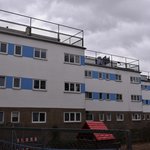
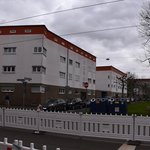
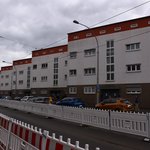
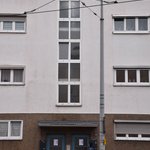
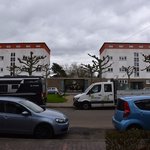
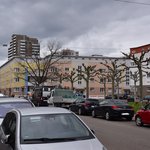
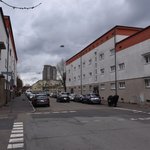
As a result, while green inner courtyards were created, some of them incorporating small gardens, the overall layout continued the traditional block structure of the preceding period, without fully integrating landscaped garden schemes. This gave rise to the eastern part of the estate, which became colloquially known as Zickzackhausen (zigzag place). The nickname, coined by residents, refers to the characteristic angled arrangement of the buildings, designed to maximise exposure to light. These houses are arranged in relatively compact blocks and feature roof terraces. Typically, the bedrooms face the street, while the living rooms overlook the courtyard. Within one of these courtyards stands a larger building used as a kindergarten. This location proved particularly beneficial for both the children and the staff, as the kindergarten is situated in a green, and safe setting, well away from the streets.

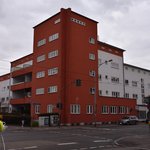
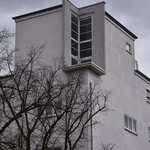
In the western part of the estate, by contrast, the buildings follow a more linear arrangement along the streets, with corners often accentuated by tower-like elements that form the highest points of the development. At the far western edge of the estate, along Donnersbergstraße, terraced houses were built as single-family homes, each with its own garden.

All flats were equipped with the Frankfurt Kitchen, and most were two- or three-room units ranging from approximately 56 to 65 square metres. A particularly notable feature was that, alongside central heating, each flat was also fitted with a centralised radio system - an innovative amenity at the time. This new medium was seen as emblematic of the spirit of New Frankfurt.

Description

As the topography played a decisive role in shaping the development, the planning here is closely integrated into the existing urban fabric. Rather than being conceived as a detached satellite estate in the green, it was more organically connected to the surrounding city and built upon earlier plans for the site. The layout of the estate was designed by Ernst May in collaboration with Herbert Boehm, while the architectural design was carried out by Ernst May together with Carl-Hermann Rudloff.

As a result, while green inner courtyards were created, some of them incorporating small gardens, the overall layout continued the traditional block structure of the preceding period, without fully integrating landscaped garden schemes. This gave rise to the eastern part of the estate, which became colloquially known as Zickzackhausen (zigzag place). The nickname, coined by residents, refers to the characteristic angled arrangement of the buildings, designed to maximise exposure to light. These houses are arranged in relatively compact blocks and feature roof terraces. Typically, the bedrooms face the street, while the living rooms overlook the courtyard. Within one of these courtyards stands a larger building used as a kindergarten. This location proved particularly beneficial for both the children and the staff, as the kindergarten is situated in a green, and safe setting, well away from the streets.

In the western part of the estate, by contrast, the buildings follow a more linear arrangement along the streets, with corners often accentuated by tower-like elements that form the highest points of the development. At the far western edge of the estate, along Donnersbergstraße, terraced houses were built as single-family homes, each with its own garden.

All flats were equipped with the Frankfurt Kitchen, and most were two- or three-room units ranging from approximately 56 to 65 square metres. A particularly notable feature was that, alongside central heating, each flat was also fitted with a centralised radio system - an innovative amenity at the time. This new medium was seen as emblematic of the spirit of New Frankfurt.

History

Planning for the housing estates began in 1925, and construction commenced in 1926. Like others of its kind, it reflects the city’s approach of continuous urban expansion rather than being conceived as a self-contained settlement, which was characteristic of the New Frankfurt programme. The estate was completed by 1927, allowing tenants to move in.

However, living here was by no means inexpensive. A deposit of between 700 and 1,200 Reichsmarks (RM), depending on the size of the flat, was required. Initial monthly rents ranged from 48 to 88 RM, amounting to nearly half the income of an average worker. At the time, households typically relied on a single earner, usually the man, making the financial burden quite significant.

As a result, the estate was primarily occupied by more affluent groups, such as civil servants, who could afford these costs.

History

Planning for the housing estates began in 1925, and construction commenced in 1926. Like others of its kind, it reflects the city’s approach of continuous urban expansion rather than being conceived as a self-contained settlement, which was characteristic of the New Frankfurt programme. The estate was completed by 1927, allowing tenants to move in.

However, living here was by no means inexpensive. A deposit of between 700 and 1,200 Reichsmarks (RM), depending on the size of the flat, was required. Initial monthly rents ranged from 48 to 88 RM, amounting to nearly half the income of an average worker. At the time, households typically relied on a single earner, usually the man, making the financial burden quite significant.

As a result, the estate was primarily occupied by more affluent groups, such as civil servants, who could afford these costs.

Sources

Construction types
masoned
Facades
plaster
Windows
casement fixed ribbon corner
Roof
flat
Details
railing tower roof terrace passage
Position
along a street periphere/neighbourhood
Storeys
6

Impressions

Gallery image of Bruchfeldstraße Gallery image of Bruchfeldstraße Gallery image of Bruchfeldstraße Gallery image of Bruchfeldstraße Gallery image of Bruchfeldstraße Gallery image of Bruchfeldstraße Gallery image of Bruchfeldstraße Gallery image of Bruchfeldstraße Gallery image of Bruchfeldstraße Gallery image of Bruchfeldstraße Gallery image of Bruchfeldstraße Gallery image of Bruchfeldstraße Gallery image of Bruchfeldstraße Gallery image of Bruchfeldstraße Gallery image of Bruchfeldstraße Gallery image of Bruchfeldstraße Gallery image of Bruchfeldstraße Gallery image of Bruchfeldstraße Gallery image of Bruchfeldstraße Gallery image of Bruchfeldstraße