Stjepan Planić completed theState Technical School in Zagreb in 1920 and immediately began working in the office of Rudolf Lubynski, where he stayed until 1922. After military service he served as a site manager at Ivančić & Wolkenfeld until 1927, when he opened his own architectural atelier.Alongside professional work he studied architecture under Drago Ibler, graduating from the Zagreb Academy of Fine Arts (architecture department) in 1931.
The 1930s represent Planić’s most important creative decade. He developed a distinct synthesis of functionalism, organic principles, and regional building traditions, marked by unconventional layouts, economical solutions, and attention to landscape design. He was a member of the Zemlja (Earth) group from 1932–35, participating in its socially engaged exhibitions on housing, settlements, and peripheral urbanism.
The early Sokol Hall (1931) still shows expressionist influences; his later public buildings demonstrate a fully developed modernist sensibility. Planić’s speciality was residential design - over 600–700 projects, dominated by single-family homes, including the Fuhrmann Villa, a landmark of Croatian modernism. During the Second World War Planić hid the Jewish Fuhrmann family, an event directly connected to one of his most celebrated houses.
Planić introduced horizontal ribbon windows, deep loggias, roof terraces, and innovative interior spatial planning into Zagreb’s interwar architecturem, e. g. Napredak Cooperative Office–Residential Tower.
Post-1945 he produced numerous public buildings, mountain lodges and coastal houses across Croatia (Čakovec, Kalnik, Požega, Novi Vinodolski, Vis). He continued designing privately after retiring in 1970.
Sources
Buildings
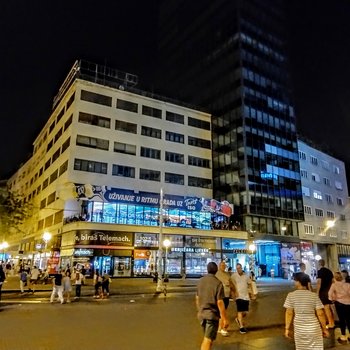
Zagreb, Croatia
Foundation Block