Ernst May, who likely completed his studies in 1913, made a major name for himself primarily as Frankfurt am Main’s chief city building officer from 1925 to 1930. During this period, the so-called Frankfurt School emerged, along with the famous Frankfurt Kitchen. A total of 26 housing estates were built across the city. He also published the journal Neues Frankfurt. With this work, he promoted and pursued the standardization of urban planning, the development of small apartments, and efforts to combat the housing shortage.
Like many architects of his time, he accepted an invitation to the Soviet Union, where he worked until 1933 on large-scale projects aligned with communist planning ideals, including the city of Magnitogorsk. However, he ultimately turned away from all forms of European dictatorship and, drawing on his connections with British colleagues, made his way to Africa. Likely influenced as well by the colonial conditions there, he established a farm in Tanzania in 1934, before later resuming his architectural career in Kenya.
After being interned during the Second World War and facing subsequent difficulties returning to West Germany, he nevertheless went on to serve from 1954 to 1956 as head of planning for the housing and development company “Neue Heimat” in Hamburg, where he was responsible, among other things, for the urban planning of Neu-Altona. By that point, Frankfurt, and any continuation of his original ideas there, was definitively a thing of the past.
Today, his legacy is particularly well preserved and commemorated in Frankfurt am Main.
Sources
Buildings
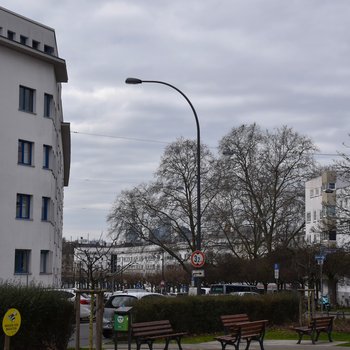
Frankfurt (Main), Germany
Bornheimer Hang