Malloch Building (Ocean-Liner House) (1937)

Feed image of Malloch Building

#Apartment house #San Francisco #USA #1937

Architects

Irvine Goldstine

Address and directions

1360 Montgomery Street
CA 94133 San Francisco, USA

Today's use: Apartment house

The Ocean-Liner House

Description

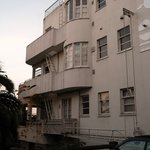
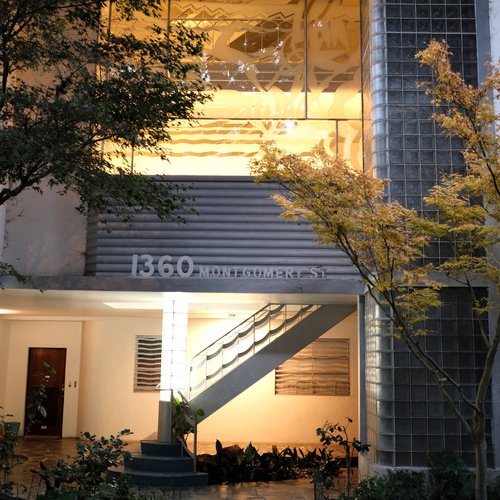
The Malloch Apartment Building is a prominent example of Streamline Moderne residential architecture in San Francisco, characterized by aerodynamic horizontal lines, rounded volumes, and a light, ship-like appearance that earned it the nickname “the Ocean-Liner House.”

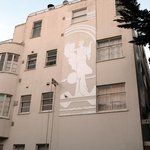
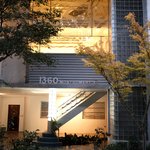
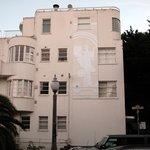
Designed by Irvine Goldstine, the building consists of four residential floors above two lower levels supported by reinforced concrete to meet seismic requirements, while the main structure above is wood-framed. Its most distinctive features include a tall glass-brick elevator shaft, a sand-etched glass panel above the entry, and three large Sgraffito murals by artist Alfred Du Pont, depicting a Spanish explorer, a worker with a globe, and a female "Spirit of California". 

The integration of sculptural decoration and streamlined forms has led architectural surveys to recognize it as one of San Francisco’s most significant examples of the style.
Description

The Malloch Apartment Building is a prominent example of Streamline Moderne residential architecture in San Francisco, characterized by aerodynamic horizontal lines, rounded volumes, and a light, ship-like appearance that earned it the nickname “the Ocean-Liner House.”

Designed by Irvine Goldstine, the building consists of four residential floors above two lower levels supported by reinforced concrete to meet seismic requirements, while the main structure above is wood-framed. Its most distinctive features include a tall glass-brick elevator shaft, a sand-etched glass panel above the entry, and three large Sgraffito murals by artist Alfred Du Pont, depicting a Spanish explorer, a worker with a globe, and a female "Spirit of California". 

The integration of sculptural decoration and streamlined forms has led architectural surveys to recognize it as one of San Francisco’s most significant examples of the style.
History

Built in 1936–1937 by developer Jack S. Malloch and his son John Rolph Malloch, the building originally contained twelve rental apartments, all of which were leased before completion. The Mallochs themselves occupied the two penthouse units. Because Irvine Goldstine had recently studied at the École des Beaux-Arts in Paris, but did not yet hold a California architect’s license, official documents originally listed only the Mallochs and the structural engineer W.S. Ellison, and the true authorship of the design was clarified decades later through historical research.

In 1947, the building gained lasting cultural visibility when it served as one of the main filming locations for the Humphrey Bogart–Lauren Bacall film "Dark Passage", where it appears on screen as Bacall’s apartment and is approached via the Filbert Steps. In the early 1980s, the property was converted from rentals into condominiums, requiring new measured drawings after the original plans had been lost in a fire.

Today it is recognized by local preservation groups and city architectural surveys as an iconic landmark on Telegraph Hill and one of the neighborhood’s most photographed buildings.

History

Built in 1936–1937 by developer Jack S. Malloch and his son John Rolph Malloch, the building originally contained twelve rental apartments, all of which were leased before completion. The Mallochs themselves occupied the two penthouse units. Because Irvine Goldstine had recently studied at the École des Beaux-Arts in Paris, but did not yet hold a California architect’s license, official documents originally listed only the Mallochs and the structural engineer W.S. Ellison, and the true authorship of the design was clarified decades later through historical research.

In 1947, the building gained lasting cultural visibility when it served as one of the main filming locations for the Humphrey Bogart–Lauren Bacall film "Dark Passage", where it appears on screen as Bacall’s apartment and is approached via the Filbert Steps. In the early 1980s, the property was converted from rentals into condominiums, requiring new measured drawings after the original plans had been lost in a fire.

Today it is recognized by local preservation groups and city architectural surveys as an iconic landmark on Telegraph Hill and one of the neighborhood’s most photographed buildings.

Sources

Construction types
reinforced concrete wood
Facades
concrete
Roof
flat
Details
balcony glass block terrace roof terrace staircase
Position
periphere/neighbourhood
Storeys
6

Impressions

Gallery image of Malloch Building Gallery image of Malloch Building Gallery image of Malloch Building Gallery image of Malloch Building Gallery image of Malloch Building Gallery image of Malloch Building Gallery image of Malloch Building