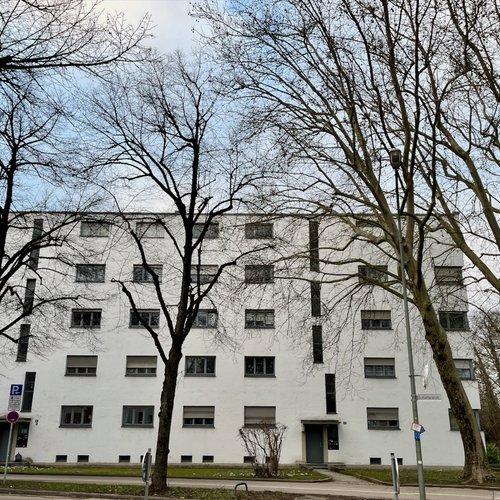
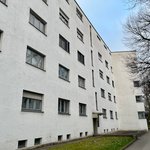
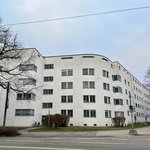
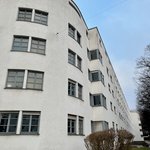
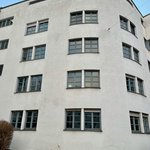
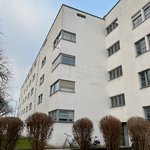
The Lessinghof in Augsburg was built between 1930 and 1931 according to designs by the German architect Thomas Wechs. The project was commissioned by the municipal housing company Wohnungsbaugesellschaft der Stadt Augsburg (WBG) as part of a broader effort to create affordable housing during the interwar period. The only requirement imposed by the city was to provide as many apartments as possible at low rent levels.
Construction began in autumn 1930, and the housing complex was completed on 1 August 1931. The Lessinghof formed part of a larger modern housing development along Rosenaustraße, together with the nearby Schuberthof, also designed by Wechs.
The residential complex originally contained 68 apartments of different sizes. Shared facilities included laundry rooms, drying attics and storage spaces in the basement, reflecting the functional planning principles of modern housing estates of the period.
Several alterations were made after the Second World War. In 1949, parts of the attic drying spaces were converted into additional apartments. A workshop building was added in the courtyard in 1959, followed by the construction of a garage block in 1967.
Together with the neighbouring Schuberthof, the Lessinghof was placed under heritage protection in 1977. The residential complex underwent a comprehensive renovation in 2004.