Eugen Radovan Tower (Toranj Eugena Radovana) (1933)

Feed image of Eugen Radovan Tower

#Multifunctional building #Zagreb #Croatia #1933

Architects

Slavko Löwy

Developers

Eugen Radovan

Address and directions

Masarykova 22
Zagreb, Croatia

Public transport: Frankopanska

Today's use: Apartments and shops

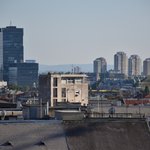
Zagreb’s First High-Rise: A Controversial Landmark of Modernism

Description

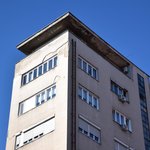
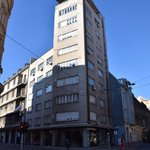
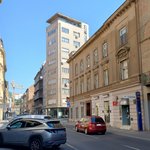
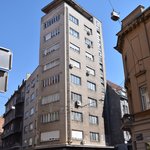
This building has never been free from debate in Zagreb. When it was completed in 1934, many considered it too tall and felt that it did not fit the character of the neighborhood. Today, some people still fail to appreciate its architectural qualities, partly because the building is in poor condition (as of 2025). The complex consists of two parts: the lower northern section, originally used as office space, and the taller section, often referred to as the tower, which contained apartments. The top floor has a smaller living area, a terrace, and a roof that follows the contours of the building. This design showcases the expressive potential of reinforced concrete, making the roof appear to float above the structure.

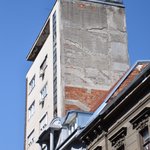
On the east façade, where plaster has fallen away, the construction method is clearly visible: a concrete frame with brick infill. The placement of the staircase can also be identified. The ground floor is used almost entirely for shops.

Description

This building has never been free from debate in Zagreb. When it was completed in 1934, many considered it too tall and felt that it did not fit the character of the neighborhood. Today, some people still fail to appreciate its architectural qualities, partly because the building is in poor condition (as of 2025). The complex consists of two parts: the lower northern section, originally used as office space, and the taller section, often referred to as the tower, which contained apartments. The top floor has a smaller living area, a terrace, and a roof that follows the contours of the building. This design showcases the expressive potential of reinforced concrete, making the roof appear to float above the structure.

On the east façade, where plaster has fallen away, the construction method is clearly visible: a concrete frame with brick infill. The placement of the staircase can also be identified. The ground floor is used almost entirely for shops.

History

Construction of Zagreb’s first high-rise began in 1933. The building was completed in just 79 days and opened in 1934, taking its name from its owner, Eugen Radovan. The structure had originally been planned at a lower height, but because the Zagreb city plan reserved surrounding areas as open space for traffic, the architect decided to build upward instead. This vertical emphasis not only ensured a more efficient use of the plot, but also created a prominent surface for large-scale advertising. The brands Bosch, Blitz, and Opel, distributed by Radovan, were promoted through striking vertical signs mounted on the façade.

Architect Slavko Löwy kept his office on the top floor, where he is believed to have spent nights as well. The forty square meters were sufficient for both living and working, reflecting his modernist commitment to reducing living space to its essential needs.

The house is also known as Loewyeva visoka kuća (Loewy high-rise) according to the architect's name.

History

Construction of Zagreb’s first high-rise began in 1933. The building was completed in just 79 days and opened in 1934, taking its name from its owner, Eugen Radovan. The structure had originally been planned at a lower height, but because the Zagreb city plan reserved surrounding areas as open space for traffic, the architect decided to build upward instead. This vertical emphasis not only ensured a more efficient use of the plot, but also created a prominent surface for large-scale advertising. The brands Bosch, Blitz, and Opel, distributed by Radovan, were promoted through striking vertical signs mounted on the façade.

Architect Slavko Löwy kept his office on the top floor, where he is believed to have spent nights as well. The forty square meters were sufficient for both living and working, reflecting his modernist commitment to reducing living space to its essential needs.

The house is also known as Loewyeva visoka kuća (Loewy high-rise) according to the architect's name.
Sources

Construction types
concrete skeleton
Facades
plaster
Windows
casement ribbon
Roof
flat
Details
railing tower roof terrace canopy lettering pillar
Position
along a street centre of a city/town/village
Storeys
10

Impressions

Gallery image of Eugen Radovan Tower Gallery image of Eugen Radovan Tower Gallery image of Eugen Radovan Tower Gallery image of Eugen Radovan Tower Gallery image of Eugen Radovan Tower Gallery image of Eugen Radovan Tower