Aquatic Park Bathhouse (1939)

Feed image of Aquatic Park Bathhouse

#Multifunctional building #San Francisco #USA #1939

Architects

William Mooser Sr., William Moser Jr.

Developers

Works Progress Administration

Address and directions

900 Beach St
CA 94109 San Francisco, USA

Public transport: Beach St & Polk St

Access: Open to public before, during or after service

Today's use: Museum

Description

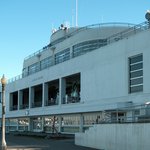
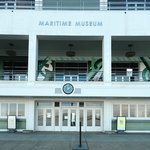
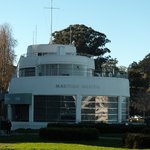
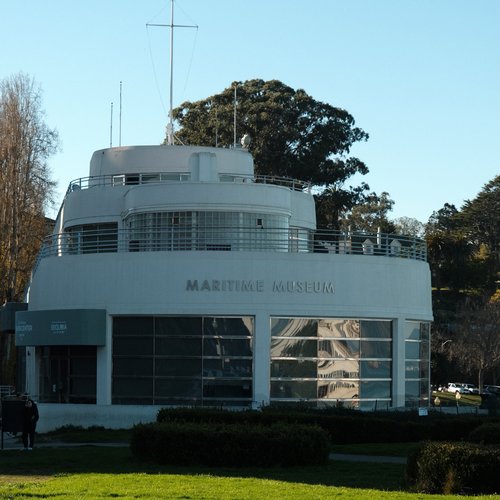
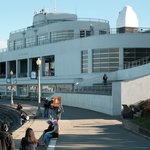
The Aquatic Park Bathhouse Building, today part of the Aquatic Park Historic District in San Francisco, is a four-story reinforced-concrete structure built in the late 1930s. Its design belongs to the "Streamline Moderne" style, deliberately evoking the appearance of a large ship at dock. The building’s main block is rectangular with semi-circular ends, upper floors are stepped back, horizontal emphasis, rounded corners, porthole-like windows, ship-type railings and steamship-style roof ventilators reinforce the nautical impression.

The bathhouse was originally painted white, with red-tiled roof terraces on the upper levels. Inside, the main lobby is adorned with colorful, marine-themed murals by the artist Hilaire Hiler, and the flooring and finishes combine terrazzo, marble wainscoting and steel doors with brass fixtures shaped like halves of ship’s wheels, all contributing to a cohesive maritime-inspired aesthetic.

Description

The Aquatic Park Bathhouse Building, today part of the Aquatic Park Historic District in San Francisco, is a four-story reinforced-concrete structure built in the late 1930s. Its design belongs to the "Streamline Moderne" style, deliberately evoking the appearance of a large ship at dock. The building’s main block is rectangular with semi-circular ends, upper floors are stepped back, horizontal emphasis, rounded corners, porthole-like windows, ship-type railings and steamship-style roof ventilators reinforce the nautical impression.

The bathhouse was originally painted white, with red-tiled roof terraces on the upper levels. Inside, the main lobby is adorned with colorful, marine-themed murals by the artist Hilaire Hiler, and the flooring and finishes combine terrazzo, marble wainscoting and steel doors with brass fixtures shaped like halves of ship’s wheels, all contributing to a cohesive maritime-inspired aesthetic.
History

The construction of the Bathhouse began in 1936 and was completed in January 1939 under the auspices of the Works Progress Administration (WPA), as part of a large public-works project to create a public bathing and recreation facility at what was formerly Black Point Cove.  Originally the building offered showers, locker rooms, changing areas for thousands of swimmers, and spectator seating for aquatic events around a nearby man-made lagoon. 

After World War II, the building’s use changed. In 1951 it became the San Francisco Maritime Museum (now part of San Francisco Maritime National Historical Park), while preserving its historic structure and interior murals.  In recognition of its architectural and historic significance, the Aquatic Park Historic District (including the Bathhouse) was listed on the National Register of Historic Places in 1984 and designated a National Historic Landmark in 1987. 

History

The construction of the Bathhouse began in 1936 and was completed in January 1939 under the auspices of the Works Progress Administration (WPA), as part of a large public-works project to create a public bathing and recreation facility at what was formerly Black Point Cove.  Originally the building offered showers, locker rooms, changing areas for thousands of swimmers, and spectator seating for aquatic events around a nearby man-made lagoon. 

After World War II, the building’s use changed. In 1951 it became the San Francisco Maritime Museum (now part of San Francisco Maritime National Historical Park), while preserving its historic structure and interior murals.  In recognition of its architectural and historic significance, the Aquatic Park Historic District (including the Bathhouse) was listed on the National Register of Historic Places in 1984 and designated a National Historic Landmark in 1987. 

Sources

Construction types
reinforced concrete
Facades
whitewashed
Windows
fixed
Roof
flat curved
Details
flagpole terrace roof terrace clock
Position
along a street with/in a garden/park periphere/neighbourhood
Storeys
4

Impressions

Gallery image of Aquatic Park Bathhouse Gallery image of Aquatic Park Bathhouse Gallery image of Aquatic Park Bathhouse Gallery image of Aquatic Park Bathhouse Gallery image of Aquatic Park Bathhouse Gallery image of Aquatic Park Bathhouse